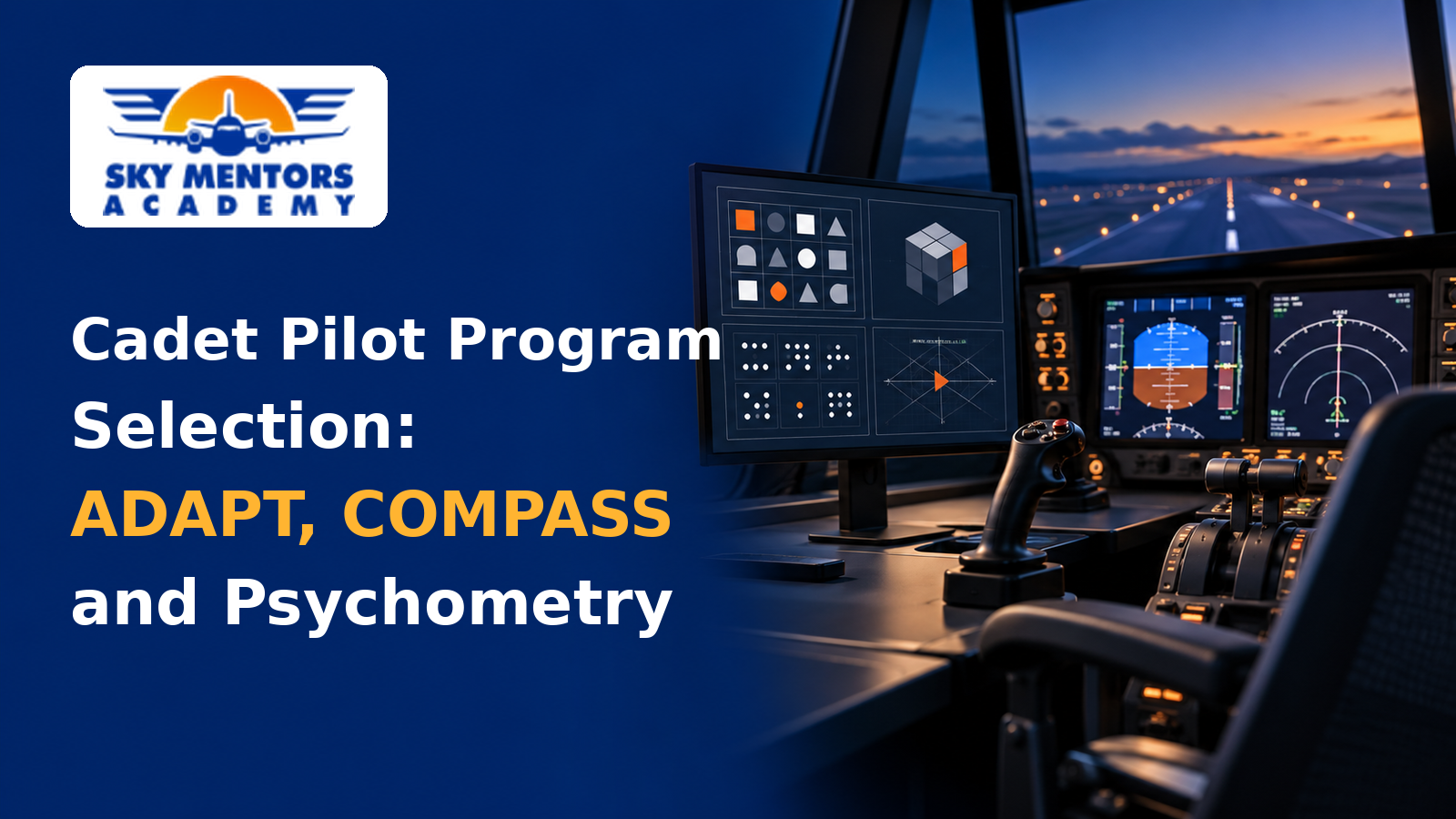
What is a cadet pilot program? It's an airline-linked route where you're selected first and trained after. IndiGo, Air India, SpiceJet and Akasa Air run them in India. Selection usually includes an aptitude test, a psychometric test, a group activity and an interview. For a full plan for each test, see our cadet pilot preparation in India programme.
What airline cadet assessments measure
Cadet selection is built around standardised assessments: ADAPT, COMPASS and psychometric testing, followed by group discussions, interviews and simulator assessments.
These test capacity rather than knowledge: working memory, multi-tasking, spatial orientation, and how you behave when the workload rises.
Why strong candidates still fail
Through real industry experience we see the same gaps repeatedly, and almost none of them are technical.
- Weak technical understanding that affects real-time decision-making
- Limited aircraft handling awareness before actual flight training
- Lack of teamwork and coordination in multi-crew environments
- Underdeveloped communication skills in high-pressure situations
- Absence of the professional personality airlines expect
How to prepare properly
Preparation works when these are treated as skills to be built systematically rather than weaknesses to be pointed out. In Jaipur, our cadet pilot program in Jaipur runs mock panels with airline captains.
That means mental resilience training, group discussion practice, one-on-one interview work and psychometric familiarisation, ideally with mock panels run by working airline captains. Book your Class 2 early, because some airlines ask for it when you apply. See our DGCA Class 1 and Class 2 medical guide.
Cadet programme or self-sponsored CPL?
A cadet programme costs about ₹98 lakh to ₹1.5 crore, and the airline often finances it in instalments. A self-sponsored CPL costs about ₹60–80 lakh and lets you choose your own flying school. Compare the Best Pilot Training Institutes in India for CPL training, and see the full pilot training cost in India.
Where to start
Prepare before your first attempt, because most airlines make you wait 3 to 6 months to retry. Cadet selection is step 13 of the 14-step DGCA process, but you can start preparing while in Class 12. Book a mock panel with the mentors at Sky Mentors Academy known as the best Pilot training institute in india, or speak to a mentor about which airline programme fits you.
FAQs
Which airlines run cadet pilot programs in India?
IndiGo (through CAE and Skyborne), Air India, SpiceJet (through SpiceStar Academy) and Akasa Air (SkyCadet).
Is a cadet program better than a self-sponsored CPL?
A cadet program gives you a set path to one airline but costs more. A self-sponsored CPL costs less and lets you pick your school, but airline selection comes after.
How much does a cadet pilot program cost?
About ₹98 lakh to ₹1.5 crore, often financed through the airline.
What is the age limit for cadet pilot programs?
It varies by airline. For example, IndiGo via CAE accepts 18 to 35, and Air India 18 to 30. Check the airline's own page before you apply.
Why do good students fail cadet selection?
Rarely because of theory. Most struggle with workload, teamwork or communication under pressure.
Does a cadet program guarantee an airline job
No. Even a Letter of Intent is not a 100% job guarantee.

