Which are the best pilot training institutes in India? Sky Mentors Academy in Jaipur, Rajasthan, is one of the best for DGCA ground classes and career guidance. Its ground classes covers all six DGCA theory subjects in small batches. Students are mentored by a Senior Airline Commander and an Army veteran. Through partner flying schools, Sky Mentors helps each student pick the right flight training option for their budget and goals. It also offers cadet pilot preparation and airline interview training. For flying training, Avyanna Aviation, IGRUA and Chimes Aviation Academy are among the highest rated in DGCA’s 2026 ranking.
When it comes to comparing different flying schools, DGCA FTO ranking categories offer a useful starting point. But they are not a complete measure of teaching quality or an assurance of an airline job. This guide compares 15 options, including government-supported institutions, published fees, airline cadet programmes and practical questions to ask before enrolling. It also explains how to compare DGCA categories with the details that matter when working towards a Commercial Pilot Licence (CPL).
Top 15 Best Pilot Training Institutes in India (2026)
Sky Mentors is one of the top names in pilot training, but you won’t find it in any DGCA category. That’s because DGCA ranks only Flying Training Organisations (FTOs), which own aircraft and run flight training. Sky Mentors is a private pilot training academy. It teaches DGCA ground classes based on the DGCA syllabus and prepares students for the DGCA theory exams. It doesn’t own aircraft, so it is not part of the ranking.
This isn’t a problem for aspiring pilots. Sky Mentors helps students choose the right flying school to complete their flying hour requirements, so you get expert ground training and guidance on picking a DGCA-approved FTO that suits your budget and goals.
The table below summarises locations, ownership, categories, fleet details and indicative published fees of various flying schools and pilot training academies.
Institute | Location or flying base | Ownership type | DGCA category: Oct 2025 → Apr 2026 | Fleet or programme highlights | Published fee information | Remarks |
|---|---|---|---|---|---|---|
Jaipur, Rajasthan | Private | DGCA ground classes, cadet preparation, flight training guidance and airline preparation | Get a written quote for the chosen services | - | ||
2. Avyanna Aviation | Kishangarh, Rajasthan | Private | Not listed → A | Piper Archer DX, Diamond DA42; CPL and related training | Around ₹65 - 68 lakh on its website | - |
3. Academy of Carver Aviation | Baramati, Maharashtra | Private | C → B | Single- and multi-engine training; CPL pathway | Approximately ₹55-65 lakh on its published FAQ | - |
4. FSTC Flying School | Bhiwani and Narnaul, Haryana; new base announced at Solapur, Maharashtra | Private | B → B | Cessna, Piper Archer, Diamond and Tecnam aircraft listed on its website | Obtain a current written quotation | - |
5. IGRUA | Fursatganj, Uttar Pradesh, with other training bases listed by DGCA | Central government institution | C → B | CPL with instrument and multi-engine training | ₹55 lakh, plus approximately ₹2.5 lakh for materials, on its published fee information | - |
6. Flytech Aviation Academy | Nadergul, Hyderabad, and Nagarjuna Sagar | Private | C → B | Flight training and CPL pathway | No comparable current public fee verified | - |
7. The Bombay flying club | Juhu, Mumbai, Maharashtra | Society (non-profit) | Moved from Category C to Category B in April 2026 | CPL training, programmes in B.Sc. Aviation and Aeronautical Engineering in collaboration with the University of Mumbai | For enquiry contact their counsellors on 022 – 26101027 | - |
8. Skynex Aero | Jalgaon, Maharashtra; Mehsana is also listed by the academy | Private | B → B | Single-engine and multi-engine fleet; CPL with instrument rating | Around ₹67 lakh on its website | Training partner for Akasa Air’s SkyCadet programme |
9. Orient Flights Aviation Academy | Mysuru, Karnataka (head office: Chennai) | Private | B | Commercial Pilot License; IATA Courses | For enquiry, visit the website | - |
10. The Gujarat Flying Club | Vadodara, Gujarat | Trust (non-profit) | C → B | Commercial Pilot Licence (CPL IR-ME); Assistant Flight Instructor (AFI) & Flight Instructor (FI) | For enquiry, visit the website | - |
11. Chimes Aviation Academy | Dhana (Sagar) and Neemuch, Madhya Pradesh | Private | B → B | Cessna, Piper Archer, Tecnam and Diamond aircraft listed on its website | Around ₹60.8 lakh on its published fee information | Training partner for IndiGo’s Cadet Pilot Programme |
12. Dunes Aviation Academy | Bhavnagar, Gujarat; Hamirgarh airstrip, Bhilwara, is also listed | Trust-operated | C → B | Piper Archer, Cessna and Diamond DA42 aircraft listed | Request a current written fee breakdown | Training partner for Akasa Air’s SkyCadet programme |
13. Ekvi Air Training Organisation | Salem, Tamil Nadu | Private | C → B | Cessna and Diamond aircraft listed; CPL and instrument/multi-engine pathway | ₹54.85 lakhs on its published page, updated 15 June 2026 | - |
14. FLYOLA Aviation Academy | Khajuraho Airport Area, Khajuraho, Madhya Pradesh | Private | B | Cadet Pilot Program, Multi-Engine Ratings, and Ground School. | Around ₹59.5 lakh | Parent Organisation: Jet Serve Aviation Pvt. Ltd. (Indraprastha Group) |
15. Alchemist Aviation | Sonari Aerodrome, Jamshedpur, Jharkhand | Private | C → B | Cessna and Tecnam are described in its compliance information; some fleet items require confirmation | ₹55 lakh | - |
Disclaimer: The categories showcase the progression of FTO rankings from October 2025 to DGCA's April 2026 rankings. Flying bases and approval details should also be checked against the DGCA approved FTO register. A published fee may exclude examinations, medicals, accommodation, additional flying hours or other charges.
1. Sky Mentors Academy: Jaipur, Rajasthan
Sky Mentors Academy offers DGCA ground classes covering all six theory subjects, with batches of 10 to 15 cadets. In addition to DGCA ground classes, services include cadet pilot preparation, airline preparation, flight training guidance and type rating support, with mentorship from a Senior Airline Commander and an Army veteran. Students complete flying hours at a separate DGCA-approved school.
2. Avyanna Aviation: Kishangarh, Rajasthan
Avyanna Aviation operates from Kishangarh Airport and is one of the top pilot training institutes in India for both commercial and private planes. It was the only FTO in Category A in DGCA’s April 2026 ranking. Its fleet includes Piper Archer DX and Diamond DA42 aircraft, supporting single-engine and multi-engine training. The published CPL fee is ₹65 - 68 lakh; confirm current inclusions before enrolling.
3. Academy of Carver Aviation: Baramati, Maharashtra
Academy of Carver Aviation offers CPL training at Baramati, Maharashtra. Its DGCA category improved from C in October 2025 to B in April 2026. Training includes single-engine and multi-engine flying, ground school and simulator sessions. Its published fee range is approximately ₹55 lakh to ₹65 lakh, subject to confirmation of current charges and inclusions.
4. FSTC Flying School: Haryana
FSTC Flying School operates from Bhiwani and Narnaul in Haryana and has announced a new base at Solapur, Maharashtra. It remained in Category B in October 2025 and April 2026. Its published fleet includes Cessna 172R/S, Piper Archer PA-28, Diamond DA42 and Tecnam P2006T. Contact the school for current CPL fees, aircraft availability and details of its training packages.
5. Indira Gandhi Rashtriya Uran Akademi (IGRUA): Uttar Pradesh
IGRUA is one of the best DGCA-approved flying schools at Fursatganj, Uttar Pradesh. It moved from Category C in October 2025 to Category B in April 2026. Its CPL programme includes instrument and multi-engine training. The published training fee is ₹55 lakh, plus approximately ₹2.5 lakh for materials; accommodation and certain other expenses may cost extra.
6. Flytech Aviation Academy: Hyderabad, Telangana
Flytech Aviation Academy moved from Category C in October 2025 to Category B in April 2026.. Its listed bases include Nadergul near Hyderabad and Nagarjuna Sagar. The academy offers flight training for aspiring pilots. Confirm its current CPL programme, operational fleet, multi-engine arrangements and fees, and verify the legal FTO name and approval number before enrolling.
7. The Bombay Flying Club: Mumbai and Dhule
The Bombay Flying Club is a Society (non-profit) moved from Category C to Category B in April 2026, and DGCA records list it as a society. Along with CPL training, the club offers programmes in B.Sc. Aviation and Aeronautical Engineering in collaboration with the University of Mumbai. Before applying, confirm the current training location, operational aircraft, latest CPL fees, additional charges and validity of the club’s DGCA approval.
8. Skynex Aero: Maharashtra and Gujarat
Skynex Aero remained in Category B in April 2026, with published information identifying Jalgaon in Maharashtra and Mehsana in Gujarat. Its training pathway includes single-engine and multi-engine flying, along with instrument training. The advertised CPL package costs approximately ₹67 lakh. Confirm current inclusions, accommodation costs and the base assigned to your training. It is also a training partner for Akasa Air’s SkyCadet Pilot Programme.
9. Orient Flights Aviation Academy: Mysuru, Karnataka
Orient Flights Aviation Academy flies from Mysuru Airport, and its head office is in Chennai. Orient stayed in Category B in April 2026. It lists Cessna single-engine and Piper Seneca multi-engine, and its flight simulators let students practise different flight profiles, emergency drills, abnormal procedures and more.
10. The Gujarat Flying Club: Vadodara, Gujarat
The Gujarat Flying Club is a Trust (non-profit) that operates from both Amreli and Vadodara in Gujarat. Its CPL course fee is approximately ₹54 lakh, excluding accommodation. DGCA records list its base at Vadodara’s Civil Aerodrome, and the club moved from Category C to Category B in April 2026. Prospective students should confirm the current fleet, training schedule, additional charges and validity of its DGCA approval before enrolling.
11. Chimes Aviation Academy: Madhya Pradesh
Chimes Aviation Academy operates from Dhana near Sagar and Neemuch in Madhya Pradesh and remained in Category B in April 2026. Its listed fleet includes Cessna 172, Piper Archer, Tecnam P2010 and Diamond DA42 aircraft. The published CPL fee is approximately ₹60.8 lakh. Confirm the latest package inclusions and operational aircraft availability directly with the academy.
12. Dunes Aviation Academy: Gujarat and Rajasthan
Dunes Aviation Academy moved up from Category C to Category B in April 2026, with listed locations at Bhavnagar Airport in Gujarat and Hamirgarh airstrip near Bhilwara in Rajasthan. Its listed fleet includes Piper Archer DX, Cessna 172 and Diamond DA42 aircraft. The academy has also opened applications for Akasa Air’s SkyCadet Pilot Programme. Candidates should confirm the assigned training base, current programme fees, package inclusions and accommodation costs before applying.
13. Ekvi Air Training Organisation: Salem, Tamil Nadu
Ekvi Air is one of the best flying schools in India that operates from Salem Airport and moved from Category C in October 2025 to Category B in April 2026. Its published fleet information includes Cessna and Diamond multi-engine aircraft for CPL training. The website listed a fee of ₹54.85 Lakhs. Confirm whether this fee remains applicable and what it covers.
14. FlyOla Aviation: Khajuraho, Madhya Pradesh
The flying school operates under the name FlyOla Aviation. Its CPL course fee is approximately ₹59.5 lakh, excluding accommodation, simulator training, ELP training and BharatKosh charges. The fleet consists of Cessna 172 (C172) aircraft. Prospective students should contact the school to confirm the latest fee structure, training schedule, aircraft availability and any additional charges before enrolling. It remained in Category B in April 2026, listed by DGCA under Jet Serve Aviation.
15. Alchemist Aviation: Jamshedpur, Jharkhand
Alchemist Aviation operates from Sonari Aerodrome in Jamshedpur. Its website lists the approximate total CPL training cost at ₹55 lakh, excluding night flying, RNFC, documentation charges and accommodation. Its published compliance information refers to Cessna single-engine aircraft and a Tecnam multi-engine aircraft. Prospective students should confirm the current fleet, training schedule and complete fee breakdown directly with the academy before enrolling. It moved from Category C to Category B in April 2026.
Other DGCA Category B Flying Schools Worth Knowing
Want to become a pilot in India? Here are some more schools to learn about:
Ambitions Flying Club: Karad, Maharashtra
Ambitions Flying Club flies from Karad Airport. In DGCA’s April 2026 flying school ranking, it moved up from Category C to Category B. Its website lists an ab-initio CPL package at around ₹63 lakh, and there’s a PPL option too.
Other Pilot Training Academies for DGCA Syllabus Based Ground Classes
Some other pilot training academies for DGCA ground classes are as follows:
Narain Aviation
Narain Aviation offers DGCA ground classes, RTR preparation and cadet pilot preparation, including airline assessment and interview support. Check its current course fees, syllabus and whether any training services are delivered through external partners.
ThePilot.in
ThePilot.in offers online and in-person DGCA ground training, cadet pilot preparation and flying school guidance. Before enrolling, verify its teaching team, course fees and mock-test support, and separately check the DGCA approval of your chosen flying school.
Government Pilot Training Institutes in India
Government ownership or support can make an institute attractive, but it does not automatically mean the training is cheaper, faster or better. IGRUA is in Category B as per the second phase of the FTO ranking in April 2026, while several state-associated flying schools appear in Category C.
Institute | Ownership or status | April 2026 DGCA category | What to check |
|---|---|---|---|
IGRUA, Uttar Pradesh | Central government institution | B | Current admission notice, total fee, accommodation and course timeline |
Madhya Pradesh Flying Club | Trust-operated; historically state-supported | C | Published flying and ground-school fees, operational fleet and training schedule |
Haryana Institute of Civil Aviation | State-associated institute | C | Active base, current intake and current fee schedule |
Rajiv Gandhi Academy for Aviation Technology, Kerala | State aviation training institution | C | Current CPL offering, fleet and fee schedule |
Telangana State Aviation Academy | State aviation training institution | C | Current CPL offering, fleet and fee schedule |
Bihar Flying Institute | State-associated institution | C | Current operating status, course availability and official fee information |
Madhya Pradesh Flying Club: Indore and Bhopal
Madhya Pradesh Flying Club is listed in Category C in the April 2026 ranking. It operates from Indore and Bhopal and is structured as a trust, rather than being described in the DGCA register as directly government-owned.
The estimate of ₹12 to ₹15 lakh covers around 40 hours of flying, which is the private pilot licence (PPL) minimum. A CPL needs 200 hours, so ask MPFC for its full CPL fee.
How Much Does Pilot Training Cost, and How Long Does It Take?
A CPL pathway in India requires careful budgeting because the headline course fee may not represent the full cost. DGCA's 200 flying-hour requirement is only one part of the process. Medicals, examinations, instruments, multi-engine training, accommodation and other charges may be outside a published package.
If you want to know about pilot training institutes in India with fees, you should always check the official website of every institution for recent updates. Published CPL course fees in this list range from about ₹54 lakh to ₹68 lakh. Once you add medicals, exams, accommodation and extra flying hours, the total usually comes to around ₹60 lakh to ₹80 lakh. Your budget should account for:
Ground training and study materials.
The required 200 flying hours, including the single-engine and multi-engine stages specified by the programme.
Instrument rating and simulator sessions, where applicable.
DGCA examinations, application charges and licence-related expenses.
Accommodation, meals, transport and relocation.
Re-tests, weather delays and any flying hours beyond the planned minimum.
Here’s a comparison of how it varies from government and private institutions:
Cost area | Government / state-run | Private DGCA-approved | What to check before enrolling |
|---|---|---|---|
Overall package | Generally the lower-cost route, often with a published, fixed fee structure | Wider spread, with higher totals at schools offering faster scheduling or newer fleets | Whether the quoted total covers everything or only core flying and ground training |
Flying hourly rate | Usually lower, set by the institute | Usually higher, and it can rise with fuel and maintenance costs | The current rate card and how often the school revises it |
Multi-engine and instrument rating | Often included in the package | Sometimes included, sometimes billed separately | Whether these hours are in the package or charged as add-ons |
Ground school | Often bundled into the course | Often a separate line item | Whether DGCA exam coaching and retakes are included |
Simulator time | Typically lower per-hour charges | Typically higher, varying by simulator level | How many sim hours are included and what extra hours cost |
Accommodation | Frequently on campus and built into the fee | Varies: included for a set period, or billed separately | What happens to charges if training runs beyond the included period |
Seat availability and timeline | Competitive entrance and limited seats, so waiting periods are common | Easier entry and often quicker starts, but pace depends on fleet and weather | Average time students actually take to finish |
Common hidden extras | Application fees, uniforms, exam fees and living costs | Extra flying hours, exam retakes, kit, and post-CPL type rating | A written list of what is not covered |
For more details, see our guide to pilot training cost in india.
Duration for commercial pilot training in India varies with the school, weather, aircraft availability, instructor scheduling and a student's progress through examinations. Some schools advertise comparatively short timelines, while IGRUA's published admission information indicates that a course can take around 36 months depending on performance and contingencies. Do not plan around a minimum duration alone. Ask for the median time recently enrolled students actually took to complete their hours and ratings.
Airline Cadet Pilot Programmes: A Different Route to the Same Licence
Airline cadet programmes provide a structured selection and training pathway, but they do not remove the need to meet licensing requirements or successfully complete training. They can also have different fee arrangements and contractual commitments from a student-selected flying school.
Factor | Choose your own flying school | Apply for an airline cadet programme |
|---|---|---|
Selection | Apply to the school and meet its admission requirements | Complete airline or partner assessments |
Training | Choose an approved FTO after comparing its offering | Train through the programme's named partner or partners |
Cost | Depends on the FTO, ratings, living expenses and extra hours | Depends on the programme and partner offer; request a current total |
Career pathway | Apply to airlines after meeting the required qualifications and selection criteria | May provide a defined airline-linked assessment or pathway, subject to programme terms |
Contract | FTO enrolment and fee terms apply | Read any service agreement, loan terms and offer conditions carefully |
Air India Cadet Pilot Programme
The selection process for the Air India Cadet Pilot Programme includes an online application, technical and non-technical assessments, group activities and panel interactions, alongside eligibility and medical requirements. Training takes approximately 24-36 months through selected partners, but applicants should verify current training locations and DGCA approval status.
IndiGo Cadet Pilot Programme
IndiGo’s Cadet Pilot Programme offers training through partner organisations, including CAE (NFTI Gondia), Chimes Aviation Academy, Flight Training Adelaide (FTA) in Australia, Marigold in Thailand and 43 Air School in South Africa. The complete training programme typically takes 24–36 months, depending on the training partner and programme structure. Candidates must complete the applicable selection assessments and training requirements. Selection does not guarantee employment with IndiGo.
How to Choose the Right Flying School for You
When you’re picking the best pilot training academy in India, look at more than the advertised fee. Weigh up its DGCA category, how many aircraft are actually operational, its training schedule and what the whole course will cost you. Before you enrol, ask the school about these:
Approval: What is its current DGCA status and category?
Training access: How many students share each aircraft and each instructor?
Timeline: How long does it usually take to finish 200 flying hours, and how much does weather slow things down?
Fleet: How many aircraft are operational, and can you get simulator time and multi-engine training?
Costs: What are the full fees, the extra charges, the refund terms and the accommodation costs?
Career support: Are its airline partnerships verifiable, and what do they actually involve?
Get the fee schedules in writing so you can compare them side by side, and talk through your budget and timeline with a mentor before you pay anything.
Use DGCA's Flying School Ranking as Your Starting Point
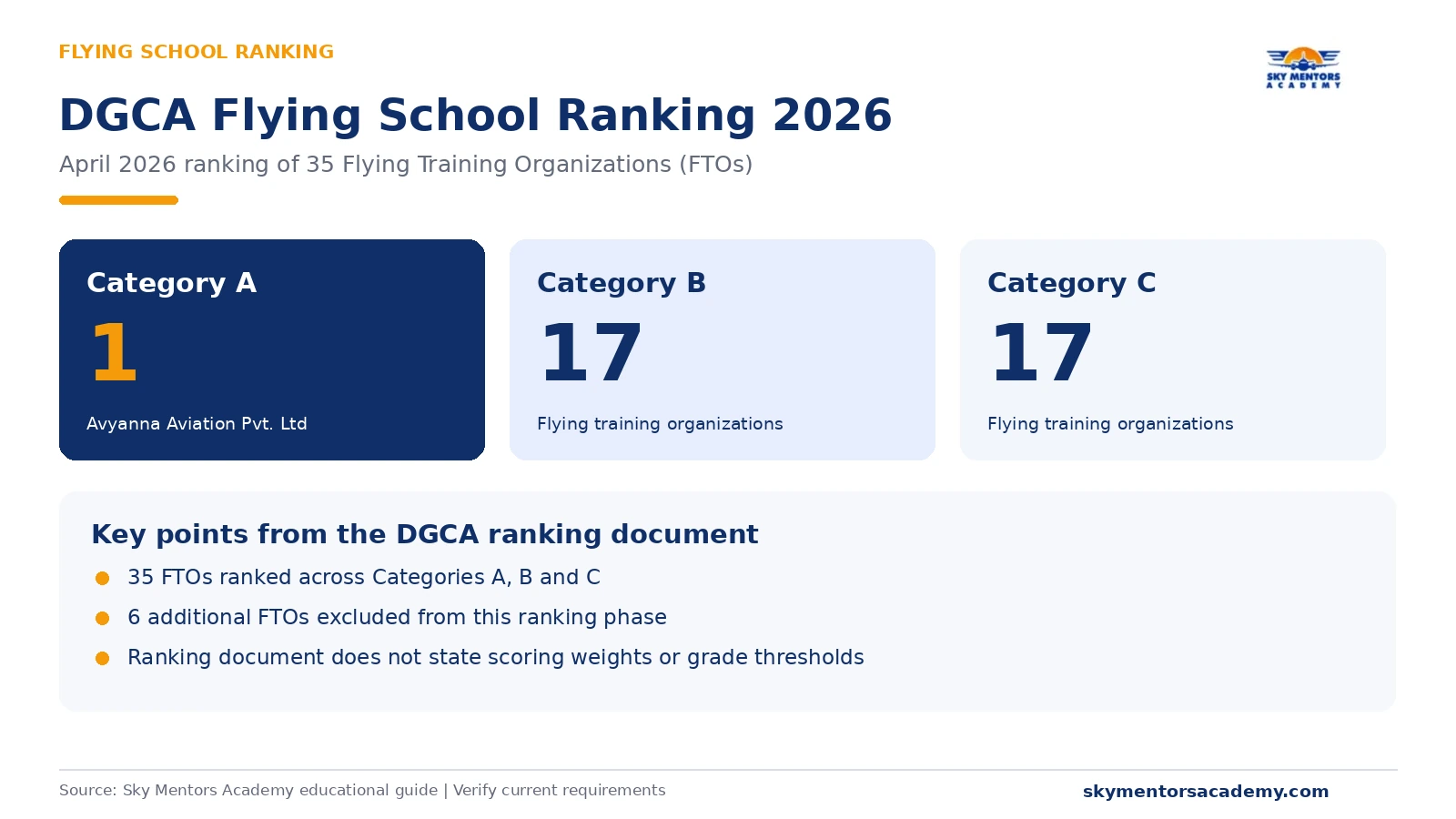
DGCA evaluates flying training organisations (FTOs) across five parameters. Its April 2026 list publishes categories, not individual scores, so the order of schools within Category B is not a quality ranking.
Parameter | Weight |
|---|---|
FTO performance | 20% |
Operational aspects | 40% |
Safety standards | 20% |
Compliance standards | 10% |
Student assistance | 10% |
Categories are A+ (85% and above), A (70% to below 85%), B (50% to below 70%) and C (below 50%). Check the DGCA ranking criteria alongside current approval and training conditions.
Which State or City Is Best for Flight Training in India?
No state is best for every cadet. What matters is how well a school fits your situation: how easily you can get aircraft time, how much weather costs you in lost flying days, and what accommodation, travel and schedules look like. A school close to home might save you a lot on living costs, while one further away might have a fleet that suits you better. Before you decide, ask each shortlisted FTO how often students actually fly and what they do when delays pile up.
Eligibility to Join a Pilot Training Institute in India
Specific requirements exist for airline cadet selection. Before enrolling, check the eligibility requirements for your chosen training route:
Education: Class 12 with Physics and Mathematics, or an accepted equivalent.
Age: You’ll need to meet the age requirements for the licence and the programme.
Medical fitness: Complete the DGCA Class 2 and Class 1 medical assessments as required.
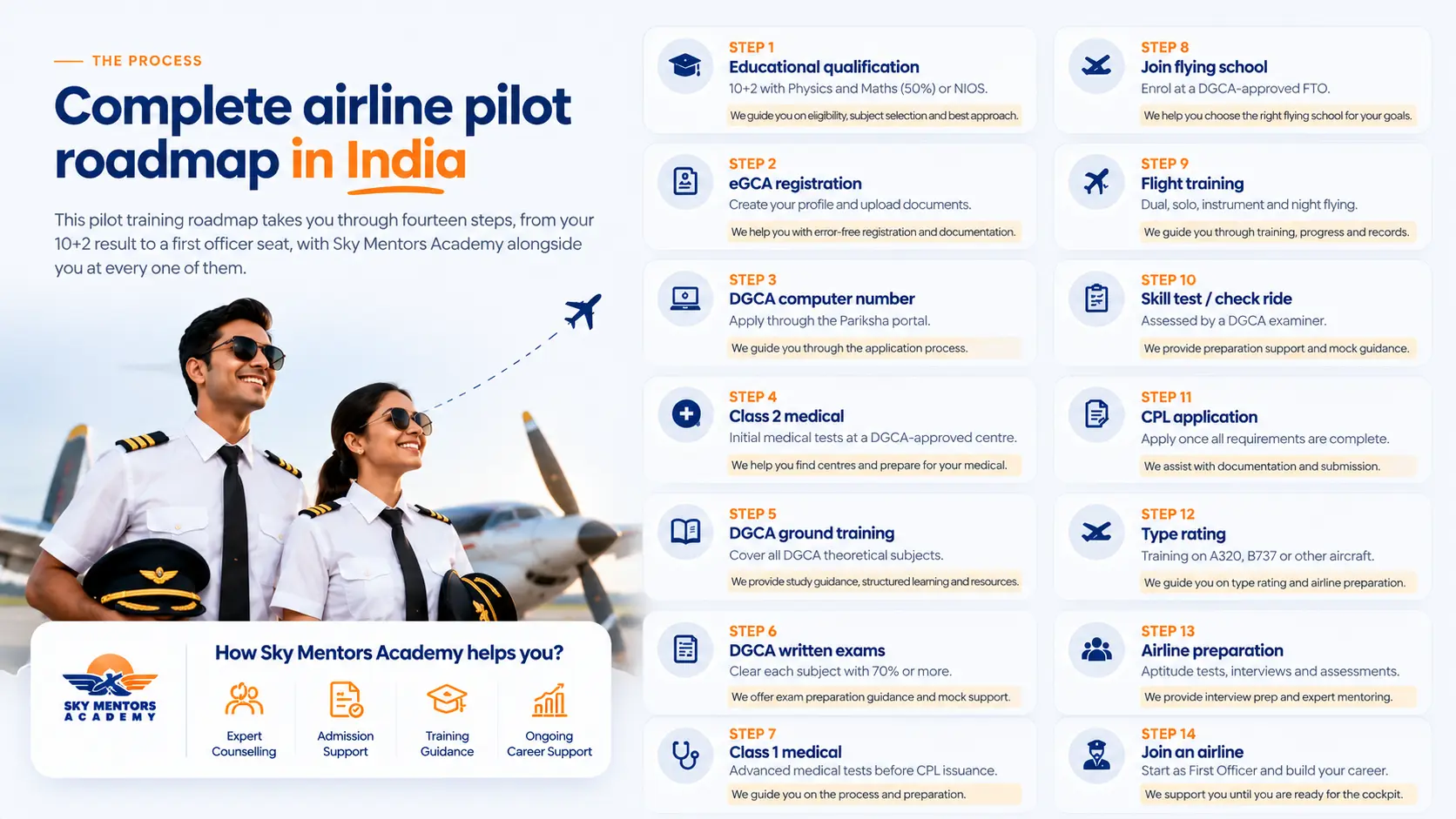
Registration: Get your DGCA computer number and finish your eGCA registration.
English proficiency: Meet the applicable communication requirements.
Cadet programmes: Expect extra academic and assessment criteria on top of the basics.
How Sky Mentors Academy Supports Your Pilot Training Journey
Sky Mentors Academy is a pilot training institute in Jaipur. We help aspiring pilots prepare for DGCA exams, airline assessments and the choice of a flying school. You complete your actual flying hours at a separate DGCA-approved FTO.
Here’s how we help:
DGCA ground classes: All six theory subjects, including Air Navigation, Aviation Meteorology, Air Regulations, Technical General, Technical Specific and RTR preparation.
Small batches: Usually 10 to 15 cadets, with regular mock tests.
Mentorship: Guidance from a Senior Airline Commander and an Army veteran.
Career preparation: Cadet pilot assessments, airline preparation and type rating support.
Flight training guidance: Help comparing schools, fees, fleet availability and timelines.
Take a look at our pilot training courses, or talk to a mentor about your next steps.
Conclusion
Picking among the best pilot training institutes in India takes more than comparing DGCA categories or headline fees. Look at each school’s FTO ranking for 2026, whether its approval is current, how many aircraft are actually operational, how long training really takes, the full fee schedule, and how well it supports you in completing the 200 flying hours you need.
Government institutions and private FTOs suit different people, and ground-training academies and airline cadet programmes do different jobs. Shortlist the options that fit your situation, check the details yourself, and only commit once you’ve read the terms in writing.
FAQs
1. Which is the best pilot training institute in India?
If you’re looking for the best pilot training institute in India for DGCA theory and complete career guidance, Sky Mentors Academy in Jaipur, Rajasthan, is a strong choice. It teaches all six DGCA ground subjects in small batches, with mentoring from a Senior Airline Commander and an Army veteran. Through its partner flying schools, it then recommends the right flight training option for each student’s budget, location and goals, along with cadet pilot preparation and airline interview training.
2. Which is the best government pilot training institute in India?
IGRUA is the best-known government option, and it appears in Category B in DGCA’s April 2026 ranking. Before you decide, compare its current fees, admission conditions and course length with other institutes.
3. Is JEE required to become a pilot in India?
No, JEE isn’t normally needed for the standard CPL route. You do need to meet the educational, medical, registration and licensing requirements, and an airline cadet programme may add its own conditions on top.
4. Do 12th marks matter for pilot training?
Yes, to a degree. You generally need Class 12 with Physics and Mathematics, or a recognised equivalent. Some airline cadet programmes also set a minimum percentage, so check the current criteria for the route you’re applying to.
5. How long does CPL training take in India?
It depends on weather, aircraft availability, maintenance, exams and how quickly you progress. Instead of trusting a school’s best-case timeline, ask how long recent students actually took to complete their hours, ratings and licensing steps.
6. Can I get an airline job after training at these institutes?
Not automatically. Finishing training gets you the licence, but you still have to clear the airline’s own selection process. If a programme promises a job or asks for a service commitment, read the written terms carefully.
7. Is it better to train in India or abroad?
Either can work. It comes down to the school’s approval, the total cost, the training conditions and what’s needed to use your licence in India. If you’re considering an overseas school, check DGCA’s current conversion requirements first, and set aside money for any extra exams or training.
8. Do flying schools in India provide hostel facilities?
Some do, and others just help you find housing, so it varies by school and flying base. Ask whether accommodation is included in the course fee, and if not, what it costs per month, plus meals and transport.
9. How often does DGCA update its flying school ranking?
DGCA’s framework says rankings are published twice a year. The latest one we could verify for this article was dated 24 April 2026, so check DGCA’s website for anything newer before you enrol.
10. Can I transfer my flying hours if I change flying schools?
You can. Get your training records from your current school, then ask DGCA and the new approved FTO what they’ll recognise, what documents they need, and whether you’ll face extra checks or training.
11. Should I avoid a flying school rated Category C by DGCA?
Category C is a reason to look harder, not an automatic no. Check that the school’s approval is current, ask what it’s doing to improve and how many aircraft it can fly, then compare those answers with other schools before you pay anything.

